"Holidays Are What You Bake Them" Craft Fair Review
First Impressions: A Warm, Festive Vibe
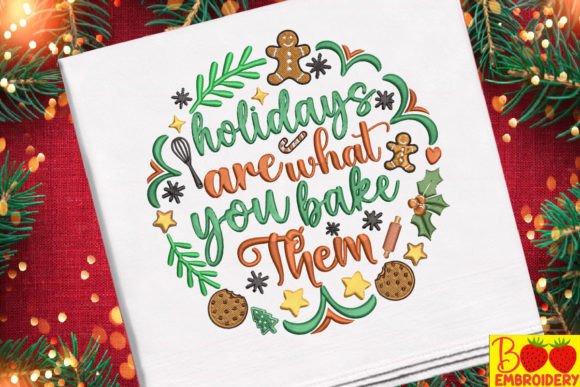
When I first read the title Holidays Are What You Bake Them, I immediately pictured a cozy kitchen scene. The phrase itself feels like a clever twist on a familiar saying, blending the warmth of holiday baking with the joy of handmade gifts. From a designer's perspective, this is exactly the kind of word art that stops customers mid-stride at a craft fair. It's not just a Christmas embroidery design; it carries a sentiment that invites nostalgia and a chuckle. The description confirms it's meant to decorate "your favorite Christmas embroidery projects," so I'm already imagining it stitched out on a flour-dusted apron or a tea towel hanging by the oven. The tone is playful yet sweet, leaning toward a modern farmhouse or rustic kitchen aesthetic. It's not overly cutesy, nor is it formal. It straddles that perfect middle ground where a boutique maker can dress it up or down depending on the product. The phrase has a dual meaning that works for both the baker and the person who loves to "bake" up holiday memories, making it a conversation starter. I'd place this design firmly in the category of smart giftables—the kind people buy not just for themselves but for the foodie friends and family members who live in the kitchen during the holidays.
Where This Design Shines in a Craft Fair Booth
When I plan a booth, I think about what catches the eye from ten feet away, then what draws someone in closer. Holidays Are What You Bake Them has a strong typographic presence that can be read from a distance if sized appropriately. I'd test it as a large focal design on a few key products and also as a smaller accent. Let's walk through the product categories where I believe it will perform best.
Tote Bags and Market Bags
A natural canvas for this design is a sturdy canvas tote. For a holiday market, a tote with a witty baking pun becomes a reusable shopping bag that customers will use all season long. I'd stitch it on a natural cotton tote in a contrasting thread color—maybe a deep evergreen or rich burgundy on cream. The layout should be centered and large enough to fill the front panel without overwhelming the bag's seams. Because tote fabric is typically medium-weight and smooth, stitch quality should be excellent with minimal push-through, as long as I use a medium-weight cutaway stabilizer. I can already picture these moving quickly at a booth, especially if displayed near baked goods or kitchen-themed items.
Kitchen Linens: Aprons and Tea Towels
This is where Holidays Are What You Bake Them truly belongs. An apron with this phrase across the bib instantly elevates it from a simple hostess gift to a personalized, boutique item. I'd choose a bib apron that has a smooth front, avoiding heavy topstitching that could interfere with the embroidery file. For tea towels, I'd lean toward flat-weave cotton or linen blends—textured towels can be tricky, but if the design isn't too dense, it can still work. I'd test a sample on a waffle-weave towel before committing to batch production. On a tea towel, a smaller, centered placement near the bottom edge or a corner accent often looks more polished than a full-width design. The design's holiday theme makes it ideal for a matching set: an apron and two tea towels tied with a ribbon, ready to sell as a gift bundle.
Pillow Covers and Home Décor
For home décor, I'd consider a 16x16 or 18x18 pillow cover in a neutral linen or soft cotton. The design could be the star of a throw pillow display, especially if I pair it with a few complementary holiday pillows. The phrase "Holidays Are What You Bake Them" on a pillow invites a cozy, lived-in feel. It's a product that photographs beautifully for online listings, too—a plush pillow with this stitching looks premium and giftable. While the description mentions clothes and home decor, I think a pillow cover is a high-margin item that craft fair shoppers love to touch and impulse-buy.
Small Accents: Patches and Pouches
If the design has clean, simplified lettering, it could be reduced to a patch size. I'd test a 4x4 or 5x7 hoop version to see if the small lettering remains crisp. A patch is a low-risk product for a fair because it's an affordable add-on or stocking stuffer. Small fabric pouches meant for cookie cutters, stamps, or baking tools could also work. Stitching the design on the front of a zipper pouch makes an instant gift for a baker. The key is to keep the design scaled so that the text doesn't become illegible threads. I'd be cautious here: if the original embroidery file has delicate serifs or thin strokes, a patch might not be the best use. I'd always test first.
Practical Production Considerations
Before I invest in thread and blanks, I go through a mental checklist of potential production pitfalls. Holidays Are What You Bake Them is a text-based design, so lettering quality is everything.
Stitch Density and Detail
If the machine embroidery design includes any decorative elements like flourishes, holly, or rolling pins, I need to check the stitch density. Too many dense areas on a thin fabric will cause puckering. On the other hand, if the design is too light, it might look sparse on a dark fabric. I'd run a test stitch-out on a scrap of the exact fabric I plan to use, using the same thread brand and stabilizer. I'd also look at the back of the embroidery: if the bobbin thread is pulling or the design feels stiff, I might need to adjust the file or switch to a softer stabilizer.
Lettering and Small Sizes
Tiny lettering can be a dealbreaker. If the phrase contains small words like "are" or "them," they must be legible at the intended size. I'd ask the digitizer for a recommended minimum size, or I'd test it myself. For a curved cap surface, I'd avoid the design unless it's been specifically digitized for caps, because text can distort on a curved profile. I'd also be careful with textured towels—loops can catch the thread and muddy the letters. A smooth, tight-weave towel is a safer bet.
Fabric Choices and Stabilizer
For light fabrics, I'd use a tear-away stabilizer with a temporary adhesive spray to prevent shifting. For dark fabrics, I'd float a piece of black or white stabilizer on top if the design has light thread colors, to prevent show-through. The hoop size is critical: I'd confirm the design fits comfortably within my most-used hoops, leaving enough margin for placement. If the description says "This machine embroidery design comes w" and then cuts off, I'd assume it comes with multiple file formats, but I'd still verify before purchasing. I never assume compatibility.
Selling Points and Customer Engagement
When a customer picks up a tea towel or apron from my booth, they're not just buying a product—they're buying a feeling. Holidays Are What You Bake Them taps into a universal love for homemade treats and family traditions. It's a design that instantly sparks a story: "My grandmother used to say that," or "I need this for my sister who bakes twelve kinds of cookies." This emotional connection turns a casual browser into a buyer. Plus, the phrase is gender-neutral enough to appeal to anyone who bakes, broadening the customer base.
For Etsy sellers and small shop owners, the design photographs exceptionally well. A flat lay of an embroidered apron with a rolling pin and scattered flour makes a stunning listing image. The typography is clear and readable even in thumbnail previews, which improves click-through. I'd also use printable mockups featuring this design to showcase the product without having to stitch out every variation. That's a huge time-saver for digital sellers offering commercial embroidery products.
On the craft fair table, I'd group all Holidays Are What You Bake Them items together in a themed display. A wooden crate, a few cinnamon sticks, and a small chalkboard sign with the same phrase would draw people in. The visual consistency builds brand trust and makes the booth feel curated rather than cluttered. If I'm selling the digital embroidery file itself, I'd print a high-quality photo of the finished product and display it prominently, because digital files sell better when customers can see the real-world result.
Designer Notes and Final Recommendations
Here's my honest take: Holidays Are What You Bake Them is a solid, marketable design for the Christmas season. It's not a design that will sit on the shelf until December 24th; it has the potential to sell all month long. However, I'd make a few careful checks before going into production. Always test on scrap fabric first. Verify thread color contrast—if the design uses a single color, make sure it pops against the chosen fabric. If it's multi-color, confirm that the color changes are manageable and that the design doesn't have excessively long jumps between sections.
I'd also check the spacing of the letters. In some digitized files, letters can be too close together, causing them to merge when stitched. A well-digitized embroidery file will have appropriate pull compensation. If I'm unsure, I'd contact the digitizer or run a test. The stabilizer choice will depend on the product: cutaway for knits and stretchy fabrics, tear-away for wovens. I'd also create at least one real, finished product mockup before committing to a large batch. That mockup will tell me how the design behaves in the real world, how it washes, and how it feels to the touch.
For those selling the finished product, commercial licensing is essential. I'd confirm that the purchase includes a license for selling finished items, or I'd contact the designer. Selling embroidered products without the proper license can lead to legal issues, especially if the design is used on high-volume bestsellers. The description doesn't specify license terms, so I'd do my due diligence before stocking my booth.
Finally, consider the booth display. A design like this works best when it's part of a larger kitchen-themed story. Pair it with other designs that complement the baking theme, like a mixer silhouette or a "Made with Love" motif. That way, customers can pick up multiple items and build a collection. The design itself is versatile enough to be the anchor of a holiday product line, and I'd definitely keep it in my rotation for at least two seasons.
Getting Ready for Your Booth
Before you load up the car, do a final quality check. Wash one of your embroidered items to see how it holds up. Check the back of the embroidery for loose threads or irritation. Photograph everything in natural light, and then in a booth-like setting, to see how the colors translate. Holidays Are What You Bake Them has the potential to be one of those designs that pays for the booth fee on its own. Just be smart about your production choices, keep the design clean and properly scaled, and let the sentiment do the selling. This is a design that belongs in a holiday market, and I'm confident it will find its way into many kitchens this season.